

No More Manual Data Entry!
One Document. Multiple Steps to Verified Data.
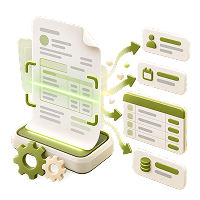
Automated Extraction
Fields, tables, and totals are read without manual typing.
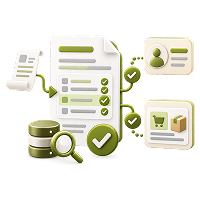
Validation and Matching
Data is checked against your rules and matched to suppliers and orders.
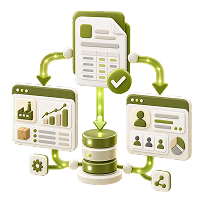
ERP and CRM Integration
Approved data lands in the system your team already uses.

Human Review
Only uncertain or incomplete documents go to a person.
See a Document Become Verified Business Data.
Manual Document Processing Slows Down the Work That Comes After It.
Invoices, purchase orders, contracts, delivery notes, and forms arrive through different channels and layouts. Teams read files, enter information, check accuracy, and route each document before the next action can begin.
Repetitive Data Entry
Teams repeatedly read and re-enter the same information.
Slow Validation and Approval
Payments and orders wait for information to be checked.
Limited Exception Visibility
Missing fields, mismatches, duplicates, and rejections are not tracked consistently.
Errors
By statistics, manual data entry brings 7-10% entry errors and missing data.
Solution
ABHER converts selected document processes into controlled digital workflows that classify, extract, validate, review, and deliver data according to approved business rules.
From Incoming Document to Approved Business Data.
Receive
Documents arrive by upload, email, scanner, shared folder, handwritten note, images, or API.
Classify
The system identifies the document type and the expected information.
Extract
Fields, tables, and text become structured data.
Validate and Match
Checked against your rules and matched to suppliers, customers, and orders.
Review
Missing, uncertain, or conflicting documents go to a person.
Deliver
Approved data is sent to the required system or workflow.
Proven AI. Real-World Impact.
A Document Workflow Designed Around Your Systems and Business Rules.Works for Any Industry
 /
/ /
/ /
/ /
/ /
/ ///////
Built Around Your Documents and Systems
Saudi Operational Understanding
Workflows designed around local operations, Arabic and English documents, approval structures, and existing enterprise systems.
Use-Case Design
We begin with the document process and the business outcome, not with a tool.
Custom Validation
Fields, matching rules, review points, and exceptions are configured to your requirements.
Connected Delivery
Approved data is delivered to your systems and teams, not left in a separate platform.
Human-Centered Automation
Routine processing is automated; uncertain cases stay with a person.

Frequently Asked Questions
Quick answers to common questions.
Invoices, purchase orders, delivery notes, contracts, reports, forms, scanned documents, and other business records. The final scope is confirmed using representative samples.
Yes. OCR reads text. This also classifies the document, extracts defined fields, applies validation rules, matches information with other records, and prepares structured output for business systems.
Through available APIs, connectors, or exchange files, subject to technical compatibility and access.
It depends on document type, layout, image quality, language, required fields, and validation rules. Targets are agreed and tested during the pilot.
Arabic, bilingual, scanned, and handwritten documents are validated using representative samples before performance targets are approved.
Required-field and format checks, confidence and validation status, duplicate and mismatch rules, exception and review queues, and human approval where required.
User access and operational ownership are defined, audit history is available where supported, and storage, retention, deletion, hosting, and data location are agreed before launch.
Select one frequent document process, provide representative samples, define the required fields and validation rules, then test against agreed acceptance criteria.
Turn One Document Process into a Smarter Connected Workflow.
Start with one document type. Validate the results. Expand with control.